Enterprise Leverage Series · Briefing 1
The Unhedged Margin: Why Your Per-Seat SaaS Stack Is an Enterprise Liability
Audio narration of the full article. Use the player controls or the Listen button. Keyboard users can tab to the audio element.
If your corporate strategy for 2026 relies on scaling headcount and renewing legacy, per-seat SaaS licenses, your organization is carrying a severe, unhedged operational liability.
The software sector market correction earlier this year—where $285 billion in SaaS market value evaporated in a matter of weeks—was not a random market anomaly. It was an institutional repricing of how enterprise work is executed. Wall Street realized a fundamental truth that many COOs are still ignoring: renting a process mediation interface is no longer worth paying for.
For two decades, enterprise software vendors built fortunes charging $150 per user, per month, under the assumption that a human user had to sit in a chair, log into a dashboard, and manually click buttons to move data between databases.
That assumption has collapsed. Forward-looking enterprises are bypassing the SaaS interface entirely, transitioning instead to custom Intent-Based Agentic Suites that query underlying data stores directly—often through the Model Context Protocol (MCP)An open standard (originated by Anthropic, now stewarded under the Agentic AI Foundation) that lets AI applications connect to tools, databases, and enterprise systems through a shared protocol—similar to a USB-C for AI integrations. Learn more about Model Context Protocol (MCP), now stewarded under the Agentic AI Foundation.
Watch: MCP in the enterprise
The cold corporate math

Legacy stack architecture
A standard 20-person regional logistics or compliance department requires specialized software licenses, CRM seats, and middleman data tools.
- Monthly overhead: ~$45,000 in personnel and seats
- Throughput: fixed to human business hours
Agentic suite architecture
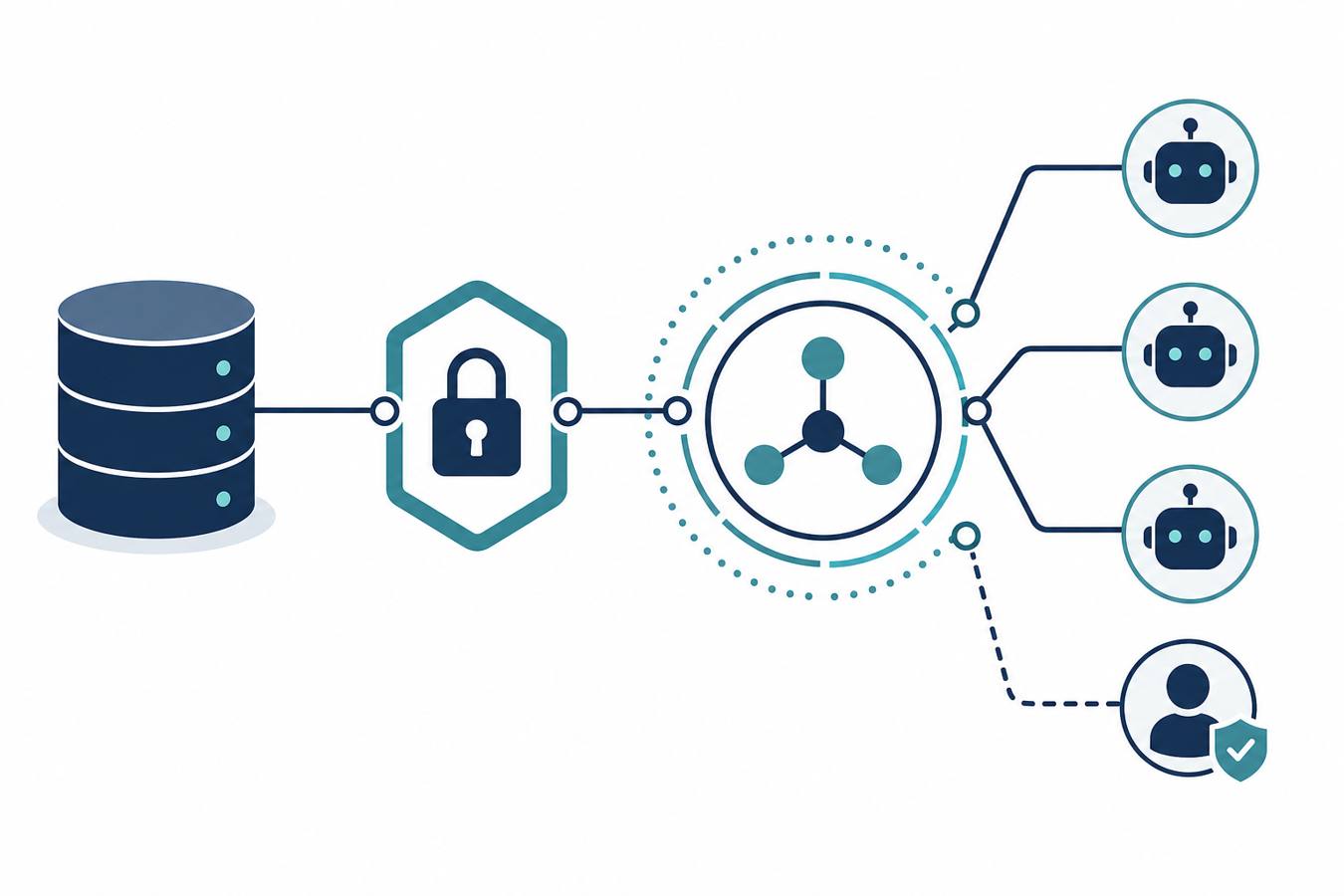
Open orchestration frameworks—LangGraphAn orchestration framework for building stateful, multi-step AI agent workflows with explicit control over branching, memory, and human checkpoints. Learn more about LangGraph or CrewAIA multi-agent framework for composing specialized AI agents that collaborate on complex tasks with defined roles and tools. Learn more about CrewAI—plus MCP servers let agents query internal databases, run compliance checks, and execute workflows.
- Compute overhead: ~$1,800/month
- Throughput: 24/7, near-instant scaling
This is not a minor efficiency gain; it is a structural transformation of your cost-to-serve metrics. If your competitor can run an identical operation with a 90% reduction in seat overhead, they can structuralize their market pricing far below your baseline cost of goods sold. Your competitive advantage will not slowly erode—it will perish.
Governance without sacrificing speed
The core hesitation for the C-suite has always been governance. How do you allow autonomous software to interact directly with core databases without risking data leaks, compliance penalties, or catastrophic hallucinations?
The answer: decoupled multi-agent networks with adversarial validation, role-based access control (RBAC)A security model that grants permissions based on job roles rather than individual identities, limiting what each agent or user can read or change., zero-trustA security approach that assumes no user, device, or agent is trusted by default—every request is authenticated, authorized, and continuously validated. boundaries, and human-in-the-loopA governance pattern where autonomous agent actions are paused for expert review before high-impact writes, payments, or external communications. checkpoints—optionally coordinated across partners via Agent2Agent (A2A)A Google-backed interoperability standard for agents to discover and collaborate with other agents across organizational boundaries while preserving security controls. Learn more about Agent2Agent (A2A).
The Enterprise Architecture Playbook
We compiled The Enterprise Architecture Playbook: Bypassing SaaS via Secure Agentic Suites—covering data boundaries, orchestration layers, and deployment roadmaps with tools like Claude, GPT-4o, MintMCP-style gateways, and AWS sidecar containers with SAML/OIDC.
Enter your corporate email below (or in the sidebar) to join the weekly Executive Briefing and request the playbook. Prefer a conversation? Schedule a free call.
This is Briefing 1 of our Enterprise Leverage Series. Next: how Agent-to-Agent protocols let procurement ecosystems negotiate supply chains under zero-trust security.
Continue the conversation
Get the Enterprise Architecture Playbook and talk through what agentic AI means for your margins.
Join the Executive Briefing
Weekly enterprise AI leverage notes and free architecture playbooks.
Schedule a free call
Book a 30-minute strategy conversation about agentic AI for your operations.
Schedule a free call
Leave a Reply